
- Industrial automation integrates machines, robots, and software to execute production processes autonomously and consistently.
- PLCs, sensors, actuators, and robotics (cobots/industrial robots) are the core components of modern automation.
- Automation delivers measurable benefits: up to 30% faster cycle times, fewer rejects, reduced human error, and data-driven process control.
- LDA Belgium offers turnkey integration of robotics, optimization of existing machines, and modular components, backed by technical expertise and rapid support.
- Automation is essential for increasing efficiency, compensating for labor shortages, and succeeding in a competitive market
Custom Industrial Automation
Today, industrial companies are struggling with declining efficiency due to outdated systems, a shortage of skilled workers, rising operational costs, and increasing competitive pressure. Industrial automation offers a solution to optimize production processes and increase productivity without relying on scarce personnel. By deploying integrated robots and software, companies can make their processes more reliable. As a technical partner, LDA Belgium offers concrete applications and benefits of industrial automation with a focus on practical implementations and added value!
What is industrial automation?
Industrial automation involves controlling machines, robots, and software to execute production processes autonomously, accurately, and repeatably. The key components are Programmable Logic Controllers (PLCs), sensors, actuators, and robotics (including cobots and industrial robots). These systems work together to automate tasks traditionally performed by humans, thereby enhancing safety.
Why industrial automation?
Industrial automation offers concrete benefits that directly contribute to the business. Automation is no longer a luxury but a necessity to remain competitive in a market with rising costs and a shortage of personnel. Automation also brings a number of advantages:
- Efficiency: Automation can shorten cycle times and reduce the number of manual steps.
- Quality: Precision is enhanced by the accuracy that a robot can achieve.
- Error reduction: Human errors in repetitive tasks are minimized.
- Data-driven control: Real-time monitoring of parameters ensures stable processes and enables predictive maintenance.
What LDA can do for you:
1. Robot integration
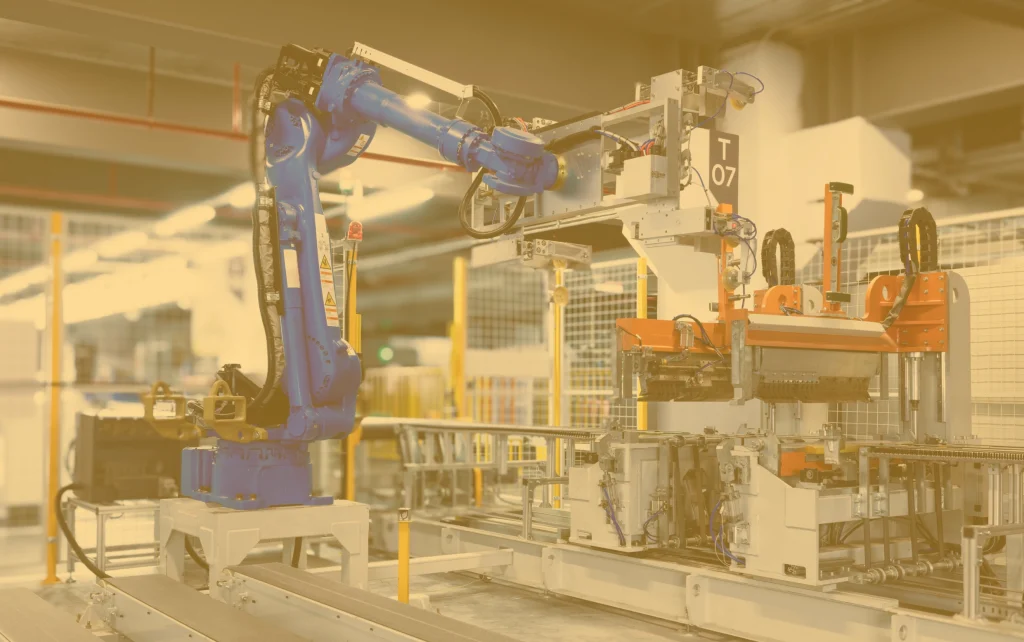
Industrial robots such as Yaskawa Motoman robots and cobots (collaborative robots) are used for tasks such as welding, palletizing, assembly, and packaging. These robots operate with precision and repeatability. They can be integrated into existing production lines, ensuring a seamless fit within production processes.
2. Optimization of existing machines
Automation can also optimize existing machines! For example, by adding airflow or air sweep systems that remove product residue and prevent blockages in hoppers. LDA Belgium installs these systems, extending the lifespan of machines because personnel no longer have to strike a hopper with a hammer. This also ensures they can focus on essential tasks
3. Integration of components
Sensors, pneumatic systems, linear guides, and other components form the building blocks of automated systems. The compatibility and modular design of these components are essential for future upgrades and flexibility. LDA Belgium supplies components and provides technical support for their integration.
Industrial Process Automation
Industrial process automation focuses on the continuous monitoring and adjustment of process variables such as temperature, pressure, flow, and level. Unlike fixed automation, process control systems use feedback loops to make adjustments in real time. This ensures stable production processes with minimal human intervention. Process automation is applicable across various sectors, ranging from chemicals and pharmaceuticals to food and energy production.
This is where PLC automation emerges as a key technology. It provides the operational foundation for monitoring and adjusting process variables. It also offers the scalability essential for modern industrial environments. But what is a PLC?
PLC automation
A Programmable Logic Controller (PLC) is an industrial computer that acts as the “brain” of automation systems. The PLC receives signals from sensors. It processes these signals using programmed logic and controls actuators to perform actions.
Operation:
- Input: Sensors detect process conditions (temperature, pressure, level).
- Processing: The PLC processes data and makes decisions based on programs.
- Output: Actuators (motors, valves, alarms) carry out actions.
Example:
A temperature sensor detects overheating in a machine. The PLC shuts down the machine before damage occurs, preventing costly repairs and downtime.
PLCs form the backbone of industrial automation and are crucial for real-time control and monitoring.
Curious about how industrial automation can optimize your production process? Contact LDA Belgium for more information.